Transpose
Norm
L2 norm has to be - scalar , dot product, can not be - matrix
The matrix is invertible(singular matrix) if its , invertible means if it has inverse or not; so if the matrix has inverse, then its det must not be 0. ( exists ⇔ ).
The matrix is non-singular if its (Determinant Test for Non-Singularity), otherwise it’s singular
Determinant
See Linear Algebra - Determinant.
Calculate Determinant
for 2x2 and 3x3, its easy to calculate
what about matrix, what will be the faster way or at least temp fast way to calculate
Laplace expansion
Rank, Linearly Independent
Systems of Linear Equations
How to Solve a Linear System (general rules):
(homogeneous case)
If then the system has a unique trivial (zero) solution.
If then the system has an infinite number of solutions.
(non-homogeneous case)
If then the system has a unique solution.
If then:
a). the system has an infinite number of solutions.
b). the system is inconsistent.
Augmented Matrix
See Linear Algebra - Augmented Matrix.
LU Decomposition
See Linear Algebra - LU Decomposition.
See Linear Algebra - LU Decomposition Example.
Eigenvalue and Eigenvector
Dot Product
is same as matrix-vector multiplication:
dot product:
outer product:
| inner/dot product | outer product |
|---|---|
| result is scalar | result is Matrix |
PSD, PD, SPD
a matrix A is positive semi-definite if
eigenvalue non-negative, including 0
a matrix A is positive definite if
eigenvalues are strictly positive, can not be 0
PD PSD
Hessian and Jacobian
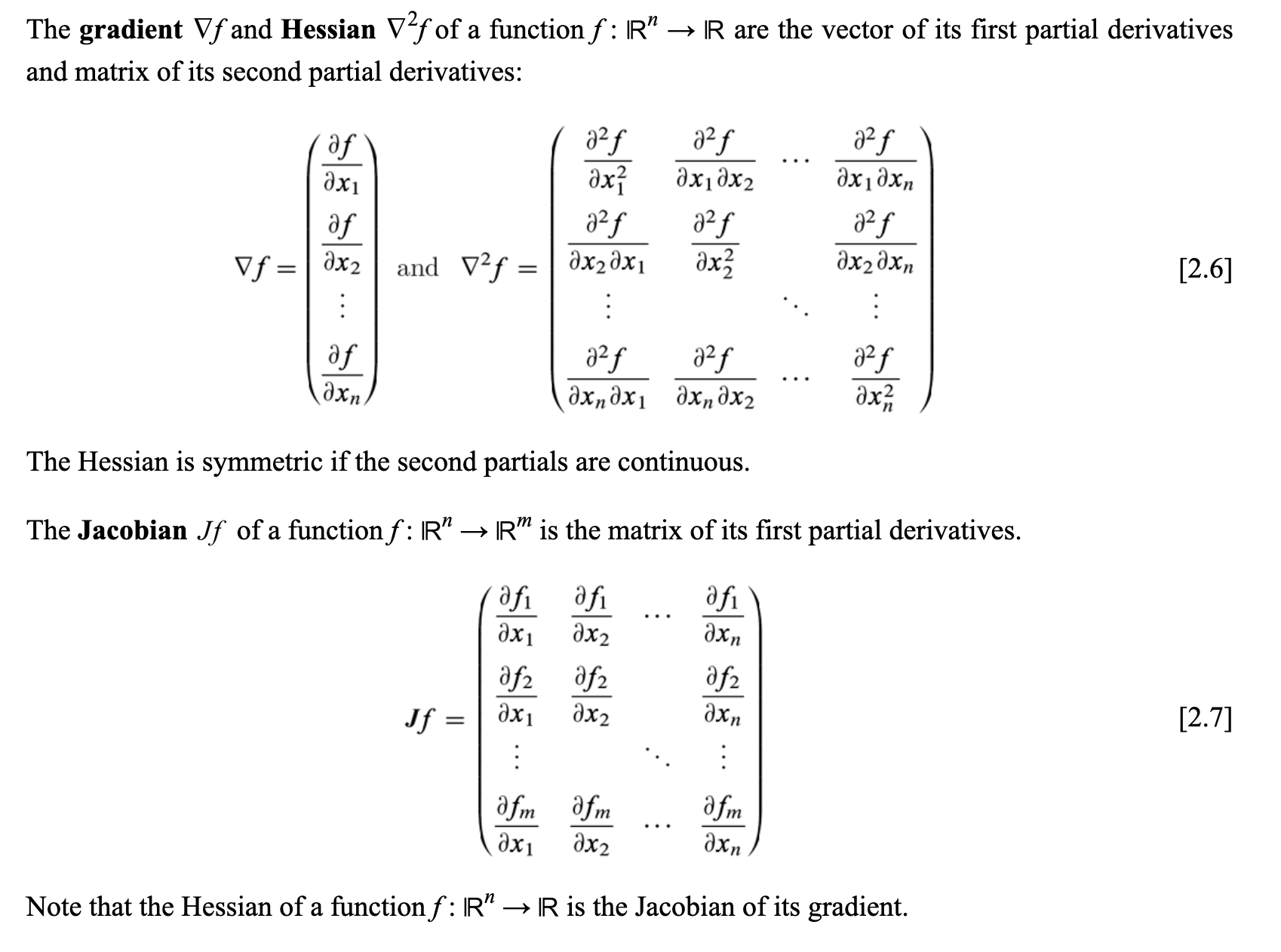
Practice question
Understanding Jacobian and Hessian matrices with example
Symmetric Matrix
Orthogonal Matrix
Reference
- A COOK-BOOK of MATH(Zotero)
- QuickMath